Physical Address
304 North Cardinal St.
Dorchester Center, MA 02124
Physical Address
304 North Cardinal St.
Dorchester Center, MA 02124


Sự tích Dưa Hấu (The Legend of the Watermelon) là một trong những truyền thuyết dân gian nổi tiếng nhất của Việt Nam, gắn liền với tên tuổi Mai An Tiêm thời Hùng Vương thứ 18. Câu chuyện này không chỉ là lời giải thích về nguồn gốc của loại quả quen thuộc mà còn là bài học sâu sắc về tinh thần tự lực cánh sinh và giá trị của lao động.
Để đáp ứng nhu cầu tìm hiểu và kể lại câu chuyện này bằng tiếng Anh, dưới đây là bản tóm tắt đầy đủ, tập trung vào các chi tiết quan trọng nhất trong truyền thuyết Mai An Tiêm.
The story of the watermelon’s origin centers on Mai An Tiêm, an adopted son of the 18th King Hùng (Hùng Duệ Vương). An Tiêm was known for his sharp intellect, resourcefulness, and diligence, earning him great favor and trust from the King.
Despite his privileged life, Mai An Tiêm possessed a distinct philosophical view: he strongly believed that true value came only from personal effort and creation. He famously stated: “What I create with my own hands is truly precious; what is given to me is a source of worry and debt (Của biếu là của lo, của cho là của nợ).”
This belief, often misinterpreted by envious courtiers, was twisted and reported to the King as a sign of arrogance and ungratefulness—suggesting An Tiêm felt his prosperity was not thanks to the King’s generosity. Enraged by this perceived defiance, King Hùng decided to punish An Tiêm severely. He banished Mai An Tiêm, his wife (Nàng Ba), and their children to a remote, deserted island, intending for them to face the harsh realities of life without royal support.
Banished to the isolated land, Mai An Tiêm and his family faced extreme adversity. However, An Tiêm’s philosophy instantly became his greatest asset. Relying entirely on his ingenuity and hard work, he quickly began building shelter and searching for food in the desolate environment.
The turning point came when An Tiêm observed a flock of birds flying over the island. He noticed they were eating a large, round fruit and dropping the black seeds onto the sandy ground. Driven by hope and curiosity, An Tiêm immediately collected these discarded seeds and decided to plant them.
This act was the ultimate expression of his belief in labor. An Tiêm carefully tended the seeds in the sand. Eventually, the seeds sprouted, grew into vines, and bore large, round fruits covered in a dark green, glossy rind. When cut open, the fruit revealed juicy, bright red flesh filled with black seeds. This fruit was the watermelon (Dưa Hấu).
The delicious, refreshing watermelon provided the family with essential nutrition and moisture, transforming their difficult existence.
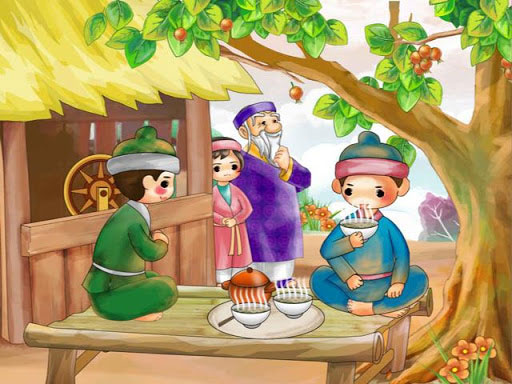
Minh họa về câu chuyện truyền thuyết Mai An Tiêm và nguồn gốc dưa hấu trong văn hóa Việt Nam
As the watermelons thrived, Mai An Tiêm found himself with a surplus. Leveraging his business acumen, he devised a strategy to communicate with the outside world. He carved his name and the location of the island onto the rinds of the largest watermelons and floated them into the ocean, hoping they would be intercepted by traveling merchant ships.
Eventually, sailors discovered these strange, branded fruits. Intrigued by the quality and the carved messages, they followed the clues back to Mai An Tiêm’s island. They were astonished to find a successful farm established in such a remote location.
The merchants quickly began trading their provisions, necessities, and food supplies for An Tiêm’s unique and sought-after watermelons. Through this trade, Mai An Tiêm’s family proved they could not only survive but also flourish through self-made commerce.
The news of An Tiêm’s success—surviving and prospering purely through self-effort and ingenuity—eventually reached King Hùng. The King realized his former adopted son had been right all along: true wealth is earned, not given. Filled with remorse and admiration, the King welcomed Mai An Tiêm and his family back to the mainland with great honors.
The Legend of the Watermelon is a foundational moral story in Vietnamese culture. The watermelon (Dưa Hấu) itself holds deep symbolic meaning, especially during Tết Nguyên Đán (Vietnamese Lunar New Year), where its dark green skin symbolizes hope and spring, and its red flesh symbolizes luck, prosperity, and joy.
| Tiếng Việt | Tiếng Anh | Ý Nghĩa Ngữ Cảnh |
|---|---|---|
| Sự tích Dưa Hấu | The Legend of the Watermelon | Tên gọi chính thức của câu chuyện. |
| Mai An Tiêm | Mai An Tiêm | Nhân vật chính của truyền thuyết. |
| Bị lưu đày | To be banished / Exiled | Hình phạt của Mai An Tiêm. |
| Tự lực cánh sinh | Self-reliance / Self-sufficiency | Triết lý sống then chốt. |
| Người tháo vát, cần cù | Resourceful and industrious man | Tính cách của Mai An Tiêm. |
| Gieo trồng hạt giống | To sow the seeds / To plant | Hành động tìm thấy nguồn sống. |
| Đảo hoang | Deserted island / Solitary island | Nơi bị đày. |
| Vỏ ngoài | Rind / Outer shell | Phần vỏ màu xanh của quả dưa. |
| Ruột đỏ mọng nước | Juicy, bright red flesh | Phần tượng trưng cho may mắn. |
| Tàu buôn | Merchant ships / Trading vessels | Phương tiện liên lạc và trao đổi. |
| Thịnh vượng | Prosperity / Affluence | Kết quả của sự lao động. |
The enduring message of Sự Tích Dưa Hấu emphasizes that hard work, perseverance, and a spirit of self-reliance are the keys to overcoming any adversity, cementing its place as a cornerstone of Vietnamese moral teaching.
Ngày cập nhật 29/11/2025 by Anh Hoàng

“Anh Hoàng” là tên thật của kyanhhoang.com, một nhà sáng tạo nội dung nổi tiếng. Hoàng chuyên về các video khám phá những địa điểm kỳ bí, rùng rợn, và các thử thách độc đáo, ít ai dám thử.